Difference between revisions of "Tensioner"
SpookySimon (talk | contribs) (→Shims: gallery mode :)) |
SpookySimon (talk | contribs) (guide in gallery format) |
||
| Line 14: | Line 14: | ||
==Guide== | ==Guide== | ||
| − | |||
Chain guides use a durable low friction material to squeeze the chain into tension. This is most commonly used for timing chains (kept lubricated inside the engine) and sometimes on bicycle<ref>https://www.specialized.com/us/en/stumpjumper-fsr-comp-evo/p/49715</ref>. | Chain guides use a durable low friction material to squeeze the chain into tension. This is most commonly used for timing chains (kept lubricated inside the engine) and sometimes on bicycle<ref>https://www.specialized.com/us/en/stumpjumper-fsr-comp-evo/p/49715</ref>. | ||
| + | <gallery class="center" heights=300px widths=300px> | ||
| + | Guide chain tensioner1.png | Guide chain tensioner diagram | ||
| + | Guide_chain_tensioner_pic.png | Tennessee Tech's guide chain tensioner in 2019 | ||
| + | </gallery> | ||
{{clear}} | {{clear}} | ||
==Idler== | ==Idler== | ||
Revision as of 14:27, 24 February 2023
A tensioner is a mechanism that necessary to a belt or chain drive to ensure long term proper function. Without correct tension, the drive system may fail catastrophically.
Contents
Tensioning Systems
There are a few ways to create tension in a belt or chain drive system. You can increase the distance between the drive and driven sprocket such as in the shimmed or eccentric systems. Another method is to lengthen the path of the chain as in the idler method.
Shims
Shims are one of the simplest methods of tensioning the chain. A shimmed system only requires a differential mount that has a vertical split that can be bolted together. By inserting shims between the front and rear halves of the differential mount(s), the differential can be moved further away. The shims can be made of any stiff material. Anecdotally these are frowned upon by design judges, but your mileage may vary.
If correctly designed, shims can be the stiffest option for tensioning the chain as the entire system will be held in compression, there are no threads, and no moving parts. The shimmed design also presents an incredibly cheap option.
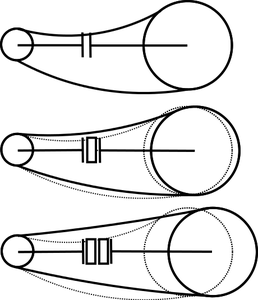
Shimmed chain tensioner diagram
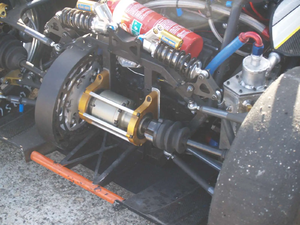
Curtain University's shimmed chain tensioner in 2012


Guide
Chain guides use a durable low friction material to squeeze the chain into tension. This is most commonly used for timing chains (kept lubricated inside the engine) and sometimes on bicycle[1].
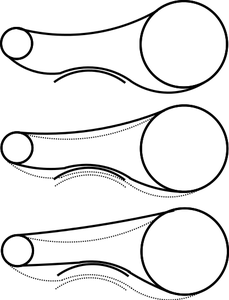
Guide chain tensioner diagram
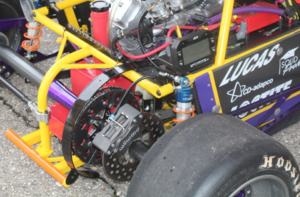
Tennessee Tech's guide chain tensioner in 2019


Idler

Another sprocket or pulley is used to add tension to the chain or belt. It does not add any torque to the system and freely spins.
Eccentric

big brain time
+rigidity
+infinite adjustability if using friction (may slip)
-design complexity
-limited finite number of tensioning options if using shear pins
Turnbuckle

Often implemented on a swing arm type design.
-play
-wear
-packaging
-rigidity[citation needed]
+infinite adjustability
can be done as a differential screw [2][3]
Footballs

- MIT used in 2006
- See Lightweight Torsen Style Limited Slip Differential and Rear Driveline Package for Formula SAE by Tony Scelfo
Toothed

