Difference between revisions of "Wire"
m (→AWG) |
m (→Voltage Drop) |
||
| Line 35: | Line 35: | ||
Voltage drop is the reduction in voltage in a circuit from the source to the load. Since all wires have resistance, there will always be a difference in voltage from one end of a wire to another if current is flowing through it. If the voltage drops too low, electrical devices may not function properly. Since a larger gauge wire will have a smaller resistance per foot, going to a larger gauge wire decreases the voltage drop. | Voltage drop is the reduction in voltage in a circuit from the source to the load. Since all wires have resistance, there will always be a difference in voltage from one end of a wire to another if current is flowing through it. If the voltage drops too low, electrical devices may not function properly. Since a larger gauge wire will have a smaller resistance per foot, going to a larger gauge wire decreases the voltage drop. | ||
| − | This is easily calculated with the formula <math>V = IR</math>, where V is the change in voltage, I is the current running through the wire, and R is the resistance of the wire. When choosing wire gauges, it might be a good idea to choose a fixed percentage voltage drop (say, 5%), and then choose all your wire gauges based on that. | + | This is easily calculated with the formula <math>V = IR</math>, where <math>V</math> is the change in voltage, <math>I</math> is the current running through the wire, and <math>R</math> is the resistance of the wire. When choosing wire gauges, it might be a good idea to choose a fixed percentage voltage drop (say, 5%), and then choose all your wire gauges based on that. |
| + | |||
===Temperature Ratings=== | ===Temperature Ratings=== | ||
As mentioned above, wires have temperature ratings. How hot a wire gets depends on the type and width of insulation, the wire gauge, whether the wire is in a bundle or by itself, and whether the wire is in free stream air or not. Annoyingly, this is really hard to quantify, so use your best judgement. Consider flexible heat shielding for wiring that gets too close to hot parts of the car (e.g., the exhaust). | As mentioned above, wires have temperature ratings. How hot a wire gets depends on the type and width of insulation, the wire gauge, whether the wire is in a bundle or by itself, and whether the wire is in free stream air or not. Annoyingly, this is really hard to quantify, so use your best judgement. Consider flexible heat shielding for wiring that gets too close to hot parts of the car (e.g., the exhaust). | ||
Revision as of 21:48, 5 August 2020
Wire is a single electrical conductor that may or may not be insulated by a jacket. See Cable for multiple conductors housed within a single jacket.
Sizing
AWG
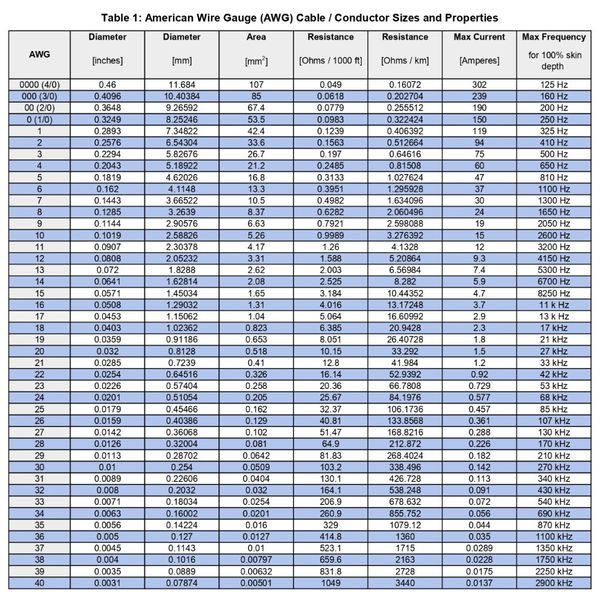
American Wire Gauge is the standard system for wire sizing in North America. Wire sizes are logarithmically stepped, with a larger gauge signifying a smaller cross section. The formula for calculating diameter of a wire for standard and metric units is as follows:
- Failed to parse (MathML with SVG or PNG fallback (recommended for modern browsers and accessibility tools): Invalid response ("Math extension cannot connect to Restbase.") from server "https://wikimedia.org/api/rest_v1/":): {\displaystyle d_n = 0.005~\mathrm{inch} \times 92^\frac{36 - n}{39} = 0.127~\mathrm{mm} \times 92^\frac{36 - n}{39}}
G(a).jpg)
Metric
Construction
Conductor
Material
Wire conductors are almost always made out of either copper or aluminum. Aluminum has 61% the conductivity of copper, but it has 30% the weight - meaning a bare aluminum wire has half the weight of a bare copper wire with the same resistance. Aluminum wire is also generally cheaper.
However, aluminum has a higher coefficient of thermal expansion than copper, and thus expands more under heat. This means it can "creep," resulting in loose connections. Aluminum can also rust, and the resulting layer of Aluminum Oxide could impede the flow of electricity. Aluminum is also a softer metal, and is thus more prone to nicks.
Solid vs. Stranded Wire
Solid conductors are made of one single strand of copper or aluminum, whereas stranded wire is made of many strands of copper or aluminum. Stranded wire is less durable, but its greater flexibility means that solid wire is hardly ever used in automotive applications.
Jacket
Material
Temperature Rating
Chemical Resistance
Abrasion Resistance
Choosing Wire Gauge
Ampacity
Ampacity is the maximum current you can safely pass through the wire. This is important for determining what wire gauge to run. A larger gauge wire will be able to carry more current, but will be heavier.
Voltage Drop
Voltage drop is the reduction in voltage in a circuit from the source to the load. Since all wires have resistance, there will always be a difference in voltage from one end of a wire to another if current is flowing through it. If the voltage drops too low, electrical devices may not function properly. Since a larger gauge wire will have a smaller resistance per foot, going to a larger gauge wire decreases the voltage drop.
This is easily calculated with the formula Failed to parse (MathML with SVG or PNG fallback (recommended for modern browsers and accessibility tools): Invalid response ("Math extension cannot connect to Restbase.") from server "https://wikimedia.org/api/rest_v1/":): {\displaystyle V = IR} , where Failed to parse (MathML with SVG or PNG fallback (recommended for modern browsers and accessibility tools): Invalid response ("Math extension cannot connect to Restbase.") from server "https://wikimedia.org/api/rest_v1/":): {\displaystyle V} is the change in voltage, Failed to parse (MathML with SVG or PNG fallback (recommended for modern browsers and accessibility tools): Invalid response ("Math extension cannot connect to Restbase.") from server "https://wikimedia.org/api/rest_v1/":): {\displaystyle I} is the current running through the wire, and Failed to parse (MathML with SVG or PNG fallback (recommended for modern browsers and accessibility tools): Invalid response ("Math extension cannot connect to Restbase.") from server "https://wikimedia.org/api/rest_v1/":): {\displaystyle R} is the resistance of the wire. When choosing wire gauges, it might be a good idea to choose a fixed percentage voltage drop (say, 5%), and then choose all your wire gauges based on that.
Temperature Ratings
As mentioned above, wires have temperature ratings. How hot a wire gets depends on the type and width of insulation, the wire gauge, whether the wire is in a bundle or by itself, and whether the wire is in free stream air or not. Annoyingly, this is really hard to quantify, so use your best judgement. Consider flexible heat shielding for wiring that gets too close to hot parts of the car (e.g., the exhaust).
Electrical Characteristics
Voltage Rating
Wire manufacturers will specify a voltage rating, which is the maximum voltage you can send through the wire. If the voltage rating is exceeded, the insulation could break down and cause a short circuit or a fire. The most common voltage rating seems to be 600V, but if you're working with high voltages this is worth double checking.
