Difference between revisions of "Wire"
Jump to navigation
Jump to search
m (→AWG) |
m (→AWG) |
||
| Line 7: | Line 7: | ||
: <math>d_n = 0.005~\mathrm{inch} \times 92^\frac{36 - n}{39} = 0.127~\mathrm{mm} \times 92^\frac{36 - n}{39}</math> | : <math>d_n = 0.005~\mathrm{inch} \times 92^\frac{36 - n}{39} = 0.127~\mathrm{mm} \times 92^\frac{36 - n}{39}</math> | ||
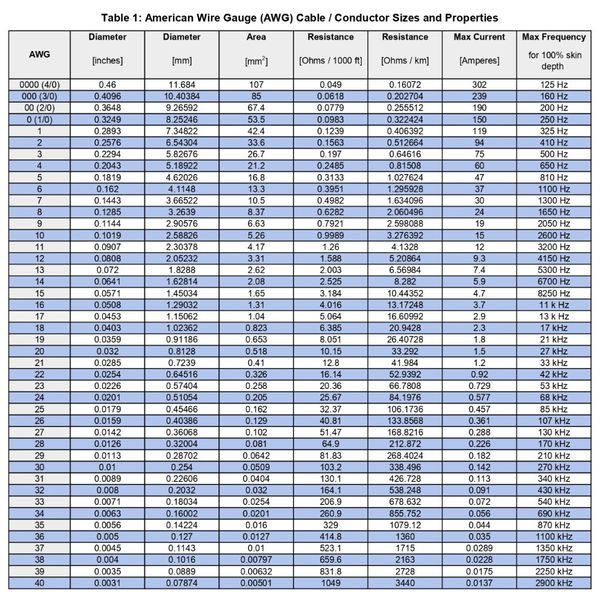
| − | : [[File:AW(oo)G(a).jpg|600px| | + | : [[File:AW(oo)G(a).jpg|600px|center|middle|frameless|AWG Chart from https://meters.co.uk/american-wire-gauge-awg-cable-conductor-sizes/]] |
: | : | ||
Revision as of 21:12, 21 May 2020
Wire is a single electrical conductor that may or may not be insulated by a jacket. See Cable for multiple conductors housed within a single jacket.
Sizing
AWG
American Wire Gauge is the standard system for wire sizing used predominantly in North America. Wire sizes are logarithmically stepped, with a larger gauge signifying a smaller cross section. The formula for calculating diameter of a wire for standard and metric units is as follows:
- Failed to parse (MathML with SVG or PNG fallback (recommended for modern browsers and accessibility tools): Invalid response ("Math extension cannot connect to Restbase.") from server "https://wikimedia.org/api/rest_v1/":): {\displaystyle d_n = 0.005~\mathrm{inch} \times 92^\frac{36 - n}{39} = 0.127~\mathrm{mm} \times 92^\frac{36 - n}{39}}
G(a).jpg)
