Difference between revisions of "Tensioner"
SpookySimon (talk | contribs) m (→Tensioning Systems: cleaning up notes) |
SpookySimon (talk | contribs) (→Stepped: words) |
||
| (5 intermediate revisions by the same user not shown) | |||
| Line 1: | Line 1: | ||
| − | A '''tensioner''' is a mechanism that necessary to a belt or [[Chain Drive|chain drive]] to ensure long term proper function. Without correct tension, the drive system may fail catastrophically. | + | A '''tensioner''' is a mechanism that necessary to a belt or [[Chain Drive|chain drive]] to ensure long term proper function. Without correct tension, the drive system may fail catastrophically resulting in damage to other components, potentially causing the vehicle to come to a sudden stop or endangering the driver or bystanders. |
=Tensioning Systems= | =Tensioning Systems= | ||
| − | There are a few ways to create tension in a belt or chain drive system. You can increase the distance between the drive and driven sprocket such as in the shimmed or eccentric systems. Another method is to lengthen the path of the chain as in the idler method. | + | There are a few ways to create tension in a belt or chain drive system. You can increase the distance between the drive and driven sprocket such as in the shimmed or eccentric systems. Another method is to lengthen the path of the chain without moving the two sprockets as in the idler method. |
| + | These can be further divided into passive systems that can automatically adjust chain tension, and manual adjustment tensioning systems that require servicing by the team to adjust tension | ||
==Shims== | ==Shims== | ||
| − | |||
Shims are one of the simplest methods of tensioning the chain. A shimmed system only requires a differential mount that has a vertical split that can be bolted together. By inserting shims between the front and rear halves of the differential mount(s), the differential can be moved further away. The shims can be made of any stiff material. Anecdotally these are frowned upon by design judges, but your mileage may vary. | Shims are one of the simplest methods of tensioning the chain. A shimmed system only requires a differential mount that has a vertical split that can be bolted together. By inserting shims between the front and rear halves of the differential mount(s), the differential can be moved further away. The shims can be made of any stiff material. Anecdotally these are frowned upon by design judges, but your mileage may vary. | ||
| − | If correctly designed, shims can be the stiffest option for tensioning the chain as the entire system will be held in compression, there are no threads, and no moving parts. The shimmed design also presents an incredibly cheap option. | + | If correctly designed, shims can be the stiffest option for tensioning the chain as the entire system will be held in compression, there are no threads to keep clean, and no moving parts. The shimmed design also presents an incredibly cheap option. |
==Guide== | ==Guide== | ||
| − | Chain guides use a durable low friction material to squeeze the chain into tension. This is most commonly used for timing chains (kept lubricated inside the engine) and sometimes on | + | Chain guides use a durable low friction material to squeeze the chain into tension. This is most commonly used for timing chains (kept lubricated inside the engine) and sometimes on bicycles<ref>https://www.specialized.com/us/en/stumpjumper-fsr-comp-evo/p/49715</ref>. |
==Idler== | ==Idler== | ||
Another sprocket or pulley is used to add tension to the chain or belt. It does not add any torque to the system and freely spins. A common implementation is the secondary sprocket on a bicycle derailleur. | Another sprocket or pulley is used to add tension to the chain or belt. It does not add any torque to the system and freely spins. A common implementation is the secondary sprocket on a bicycle derailleur. | ||
| − | An idler that is held against the chain by a spring is a passive tensioner and should not need servicing | + | An idler that is held against the chain by a spring is a passive tensioner and should not need servicing. Idlers can also be held in a fixed position with a swing arm held captive in a slot, or pinned to a fixed angle. These will need servicing as the chain lengthens. |
==Eccentric== | ==Eccentric== | ||
| Line 28: | Line 28: | ||
==Turnbuckle== | ==Turnbuckle== | ||
| − | + | Turnbuckle type tensioners offer several advantages in tensioning chain or belt drives. The design allows for infinite adjustability over a large range, reducing the required upfront design work, making them easy to implement and integrate into simple differential mounting systems. However, this design also has several disadvantages in terms of play, wear, packaging, and rigidity (citation needed). Turnbuckle type tensioners are often implemented on a swing arm design. | |
| − | + | ||
| + | Turnbuckles can be implemented as a differential screw which would increase rigidity and precision, while reducing the range of adjustment<ref>https://en.wikipedia.org/wiki/Differential_screw</ref><ref>https://www.halfbakery.com/idea/Differential_20Turnbuckle</ref>. | ||
| − | == | + | ==Stepped== |
| − | + | A stepped chain tensioner relies on two parts: a static mount attached to the frame of the car and the driven sprocket mount that is fastened only to the first mount. The interface between the two mounts has steps similar to a stepped clamp or teeth that interlace. The two pieces are kept together by a threaded fastener used to keep the steps or teeth engaged. | |
==Diagrams== | ==Diagrams== | ||
| Line 42: | Line 43: | ||
Footballchaintensioner.png|Offset Footballs | Footballchaintensioner.png|Offset Footballs | ||
</gallery> | </gallery> | ||
| − | ''need diagram of | + | ''need diagram of stepped style chain tensioner'' |
==Examples== | ==Examples== | ||
<gallery class="center" heights=300px widths=300px> | <gallery class="center" heights=300px widths=300px> | ||
| Line 48: | Line 49: | ||
Guide_chain_tensioner_pic.png | Tennessee Tech's guide chain tensioner in 2019 | Guide_chain_tensioner_pic.png | Tennessee Tech's guide chain tensioner in 2019 | ||
Eccentric chain tensioner pic .jpg|Michigan State's eccentric chain tensioner in 2019 | Eccentric chain tensioner pic .jpg|Michigan State's eccentric chain tensioner in 2019 | ||
| − | Toothed_chain_tensioner_pic.webp| Wollongong's | + | Toothed_chain_tensioner_pic.webp| Wollongong's stepped chain tensioner in 2012 |
</gallery> | </gallery> | ||
''need example images of football style, idler style'' | ''need example images of football style, idler style'' | ||
Latest revision as of 10:35, 10 March 2023
A tensioner is a mechanism that necessary to a belt or chain drive to ensure long term proper function. Without correct tension, the drive system may fail catastrophically resulting in damage to other components, potentially causing the vehicle to come to a sudden stop or endangering the driver or bystanders.
Contents
Tensioning Systems
There are a few ways to create tension in a belt or chain drive system. You can increase the distance between the drive and driven sprocket such as in the shimmed or eccentric systems. Another method is to lengthen the path of the chain without moving the two sprockets as in the idler method.
These can be further divided into passive systems that can automatically adjust chain tension, and manual adjustment tensioning systems that require servicing by the team to adjust tension
Shims
Shims are one of the simplest methods of tensioning the chain. A shimmed system only requires a differential mount that has a vertical split that can be bolted together. By inserting shims between the front and rear halves of the differential mount(s), the differential can be moved further away. The shims can be made of any stiff material. Anecdotally these are frowned upon by design judges, but your mileage may vary.
If correctly designed, shims can be the stiffest option for tensioning the chain as the entire system will be held in compression, there are no threads to keep clean, and no moving parts. The shimmed design also presents an incredibly cheap option.
Guide
Chain guides use a durable low friction material to squeeze the chain into tension. This is most commonly used for timing chains (kept lubricated inside the engine) and sometimes on bicycles[1].
Idler
Another sprocket or pulley is used to add tension to the chain or belt. It does not add any torque to the system and freely spins. A common implementation is the secondary sprocket on a bicycle derailleur.
An idler that is held against the chain by a spring is a passive tensioner and should not need servicing. Idlers can also be held in a fixed position with a swing arm held captive in a slot, or pinned to a fixed angle. These will need servicing as the chain lengthens.
Eccentric
An eccentric chain tensioner holds the driven sprocket with a round sheave[2]. The driven sprocket is held off of the neutral axis (eccentrically) such that when the sheave is turned, the driven sprocket is moved closer or farther from the drive sprocket[3]. The sheave may be constrained by friction around the circumference, teeth around the circumference or by shear pins to the larger structure. A frictional retention method allows for infinite adjustability. Teeth or shear pins mean the mount can only be tensioned in discrete steps, but the use of a vernier scale style hole pattern allows shear pins incredibly fine control. The main benefit of the eccentric mount scheme is the ability to tension the chain without removing any parts from the car, or adding new ones.
Eccentric mounts tend to be larger than other mounting schemes and thus may be inherently stiffer. By necessity, they require multiple moving parts which can drive additional complexity and design time.
Footballs
Utilizing "footballs" with eccentric mounting holes allows the sprockets to be moved further away by flipping the football within the mount itself. Unlike a traditional eccentric mount, the chain cannot be tensioned without taking the mount apart and swapping fitting direction, or swapping the fitting for a more or less eccentric version[4].
There is no reason beyond convention that the footballs need to be symmetric, a triangle or polygon of any number of sides could be used to increase the options available per eccentric football.
Turnbuckle
Turnbuckle type tensioners offer several advantages in tensioning chain or belt drives. The design allows for infinite adjustability over a large range, reducing the required upfront design work, making them easy to implement and integrate into simple differential mounting systems. However, this design also has several disadvantages in terms of play, wear, packaging, and rigidity (citation needed). Turnbuckle type tensioners are often implemented on a swing arm design.
Turnbuckles can be implemented as a differential screw which would increase rigidity and precision, while reducing the range of adjustment[5][6].
Stepped
A stepped chain tensioner relies on two parts: a static mount attached to the frame of the car and the driven sprocket mount that is fastened only to the first mount. The interface between the two mounts has steps similar to a stepped clamp or teeth that interlace. The two pieces are kept together by a threaded fastener used to keep the steps or teeth engaged.
Diagrams
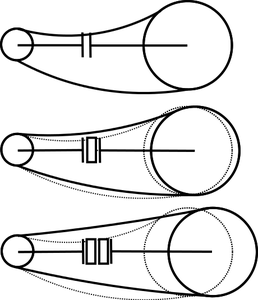
Shimmed
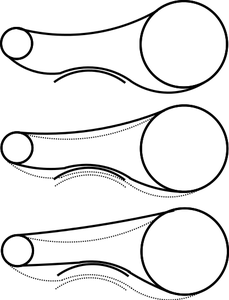
Guide
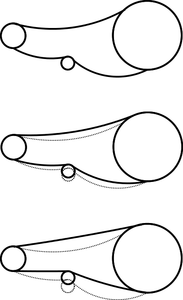
Idler Sprocket or Pulley
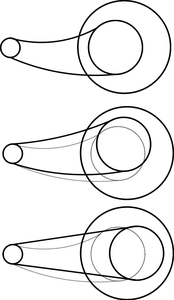
Eccentric
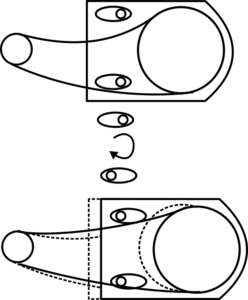
Offset Footballs


need diagram of stepped style chain tensioner
Examples
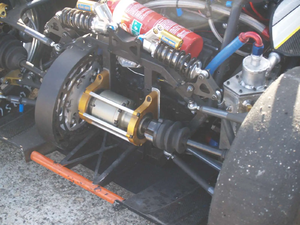
Curtain University's shimmed chain tensioner in 2012
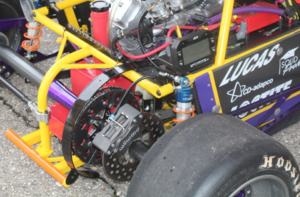
Tennessee Tech's guide chain tensioner in 2019

Michigan State's eccentric chain tensioner in 2019
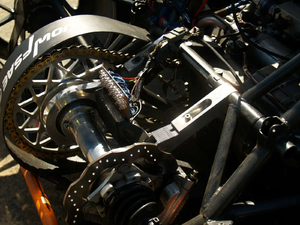
Wollongong's stepped chain tensioner in 2012


need example images of football style, idler style
References
- ↑ https://www.specialized.com/us/en/stumpjumper-fsr-comp-evo/p/49715
- ↑ Wiki article on eccentric mechanisms for clarity: https://en.wikipedia.org/wiki/Eccentric_(mechanism)
- ↑ Hansen D. Eccentric Mounting and Adjustment System for Belt Driven Devices https://apps.dtic.mil/sti/pdfs/ADD020388.pdf
- ↑ Scelfo, Tony. Lightweight Torsen Style Limited Slip Differential and Rear Driveline Package for Formula SAE 2006
- ↑ https://en.wikipedia.org/wiki/Differential_screw
- ↑ https://www.halfbakery.com/idea/Differential_20Turnbuckle
