Difference between revisions of "Tires"
Juliansch24 (talk | contribs) (→Wet) |
|||
| (5 intermediate revisions by 3 users not shown) | |||
| Line 8: | Line 8: | ||
| − | |||
| − | |||
| + | |||
| + | Tires are rubber based, with metal cords to re-enforce the structure both on the contact face, and on the vertical “side walls”. They are most commonly pneumatic (i.e inflated with air), and the result is a substantially stiff rolling structure, with the rubber generating adhesion as well as mechanical “interlocking” with the asphalt, with the result being friction.Why do tires matter? Put simply, they are the only link of the car with the ground. While almost all systems are critical for the car operation, the tires have a special role in the car’s performance - a race-car generates forces and accelerations, both through driver inputs and engine power. In this way, the tires are essentially a “gate-keeper”, where the limit of force (and as such acceleration) has an upper limit. So, more engine power, or more brake power, is only helpful if the tires can handle it. Why is more acceleration better? On a race-track, better acceleration/deceleration in a straight line means higher top speed and later braking before the corner. In a corner, better acceleration means higher corner speeds for a given radius (a=v^2/r).<br />It gets more complex. The tire is not fully rigid. If it was, it would not be able to “store” energy and generate cornering force. It is best to think of it like a spring, and cornering forces generate a torsion around the vertical axis going through the tire centerpoint. The twist angle generated is called “Slip angle”. | ||
| + | |||
| + | [[File:image34.png|center|middle|thumb|Slip angle ]]<a class="image"><img class="thumbimage" src="/images/thumb/d/db/Image34.png/300px-Image34.png" srcset="/images/thumb/d/db/Image34.png/450px-Image34.png 1.5x, /images/thumb/d/db/Image34.png/600px-Image34.png 2x" alt="" width="300" height="420" /></a> Slip angle | ||
| + | As the driver steers, the slip angle rises (and so does the cornering acceleration/force), but it does not do so linearly. This is a very important aspect of tire behavior. | ||
[[File:Image6.png|center|middle|thumb|Tire Comparison (fictional)]] | [[File:Image6.png|center|middle|thumb|Tire Comparison (fictional)]] | ||
| − | + | ||
| + | Tire Comparison (fictional)Another related aspect is “alligning torque”, which is the moment the tire exerts around its centerline to return to neutral position (pre-deformation, i.e zero slip angle). How would it generate a moment? Only if the cornering force acts at a distance from the centerline of the tire. | ||
| Line 29: | Line 33: | ||
This is where it should be noted that this torque is also non linear, relative to slip angle and to cornering force! What the driver would feel is increasing steering force, then gradually decreasing, while the car is still increasing in cornering force. This is due to the slippage of the contact patch changing location. | This is where it should be noted that this torque is also non linear, relative to slip angle and to cornering force! What the driver would feel is increasing steering force, then gradually decreasing, while the car is still increasing in cornering force. This is due to the slippage of the contact patch changing location. | ||
| + | |||
| + | |||
| + | Another factor is the tire’s relationship to vertical load - i.e, why heavier cars dont corner as well as lighter cars. Tires operate with both “adhesion” and “Hysteresis” that can also be called as “mechanical interlocking” on a macro scale with the asphalt. A sidenote - The adhesion is vastly reduced in the rain, but the Hysteresis is not affected. | ||
| + | |||
| + | |||
| + | [[File:Image14.png|link=https://www.fhwa.dot.gov/publications/research/safety/14065/002.cfm|center|middle|thumb|Mechanisms of grip ]] | ||
| + | |||
| + | |||
| + | Now, the coefficient of friction of the tire is unitless, and it is the single most important measure of tire performance - or at least, the easiest one to see at a glance. We were taught in highschool physics that this friction coefficient is constant, and independent of surface area. That is not true! On some materials it may stay very near constant. But on a rubber tire, the coefficient is actually negatively correlated to vertical load - load goes up, coefficient goes down. This is substantial enough to be the single biggest justification for making a race-car lighter.<br />Below, a primary reason for this behavior is seen. This is the macro level “interlocking” of the rubber with the asphalt, a very conventional friction model. As the vertical (i.e normal) load increases, the rubber expands to fill the road ridges, but it begins to saturate (i.e it cannot go any further into the asphalt). | ||
| + | |||
| + | |||
| + | [[File:Image29.png|link=http://insideracingtechnology.com/tirebkexerpt1.htm|center|middle|thumb|Load sensitivity ]]Consequentially, the coefficient = Fcornering/Fnormal decreases, as 1 unit of Fnormal increase results in a <1 unit of Fcornering increase - contributing to the value (being a ratio) to reduce. | ||
| + | |||
| + | |||
| + | [[File:Image20.png|link=https://en.wikipedia.org/wiki/Tire_load_sensitivity|center|middle|thumb|Load Sensitivity ]] | ||
| + | |||
| + | |||
| + | |||
| + | |||
| − | |||
| + | =Analysis= | ||
| + | ==Tire Testing Consortium (TTC)== | ||
| + | Formula SAE tire testing data is available for a one time purchase of $500 from the TTC. http://www.millikenresearch.com/fsaettc.html | ||
| − | [ | + | ==Curve Fitting== |
| + | === The Bill Cobb Approach === | ||
| + | Bill Cobb has two excellent threads on how to get started fitting. Note: TTC members only | ||
| + | * [http://www.fsaettc.org/viewtopic.php?f=17&t=23 Matlab Tire Processing Code (Report Form)] | ||
| + | * [http://www.fsaettc.org/viewtopic.php?f=13&t=216 Estimating Pacejka model coefficients in Matlab] | ||
| + | === Non-Dimensional Tire Modeling === | ||
| + | Based on the Patton 2013 Paper. <ref> Patton, Chris. Development of Vehicle Dynamics Tools for Motorsports. Oregon State University. 2013.</ref> | ||
| + | * Code is available here: https://www.mathworks.com/matlabcentral/fileexchange/67987-analyzing-tire-test-data | ||
| − | + | == Suggested Reading == | |
| + | * Pacejka, Hans. Tyre and Vehicle Dynamics. | ||
| + | * Clark, Samuel K. (Editor), Mechanics of Pneumatic Tires, 2nd Ed. U.S. Dept. of Transportation, National Highway Traffic Safety Administration, 1981. U.S. Govt. Reference #: 050-003-00377-8. | ||
| + | * Hays, D.F. & Browne, A.L., The Physics of Tire Traction. Plenum, 1973. ISBN 0-306-30806-1. | ||
| + | * Kummer, H.W. & Mayer, W.E., Unified Theory of Rubber and Tire Friction. University Park, PA.: Pennsylvania State University, 1966 | ||
| + | * Moore, D.F., The Friction of Pneumatic Tyres. Elsevier, 1975. ISBN 0-444-41323-5. | ||
=List of Tires= | =List of Tires= | ||
[https://www.millikenresearch.com/fsaettc.html Formula SAE Tire Test Consortium] | [https://www.millikenresearch.com/fsaettc.html Formula SAE Tire Test Consortium] | ||
| + | |||
| + | |||
| + | |||
| + | |||
[https://www.hoosiertire.com/tires/circuit/spec/#panel-spec Hoosier Tires FSAE 2020] | [https://www.hoosiertire.com/tires/circuit/spec/#panel-spec Hoosier Tires FSAE 2020] | ||
| − | |||
[http://www.avonmotorsport.com/resource-centre/tyre-applications/sae-formula-student Avon Tyres Formula Student] | [http://www.avonmotorsport.com/resource-centre/tyre-applications/sae-formula-student Avon Tyres Formula Student] | ||
| Line 54: | Line 94: | ||
<br /> | <br /> | ||
| + | |||
| + | |||
| + | |||
| + | |||
| + | |||
| + | |||
| + | |||
| + | |||
| Line 88: | Line 136: | ||
|- | |- | ||
|Goodyear | |Goodyear | ||
| − | | | + | | D2704<br /> |
| − | | | + | | 20.0 x 7.0-13<br /> |
| − | | | + | | 8.9LBS |
| | | | ||
| | | | ||
| Line 156: | Line 204: | ||
| | | | ||
|} | |} | ||
| − | |||
==Wet== | ==Wet== | ||
| Line 182: | Line 229: | ||
| | | | ||
|- | |- | ||
| − | | | + | |Goodyear |
| − | | | + | |D2703 |
| − | | | + | |20.0x7.0-13 |
| − | | | + | |8.8LBS |
| | | | ||
| | | | ||
|} | |} | ||
| + | |||
| + | |||
| + | |||
| + | |||
Latest revision as of 17:22, 18 January 2023
Good smelling round things
Contents
Theory Stuff
Tires are rubber based, with metal cords to re-enforce the structure both on the contact face, and on the vertical “side walls”. They are most commonly pneumatic (i.e inflated with air), and the result is a substantially stiff rolling structure, with the rubber generating adhesion as well as mechanical “interlocking” with the asphalt, with the result being friction.Why do tires matter? Put simply, they are the only link of the car with the ground. While almost all systems are critical for the car operation, the tires have a special role in the car’s performance - a race-car generates forces and accelerations, both through driver inputs and engine power. In this way, the tires are essentially a “gate-keeper”, where the limit of force (and as such acceleration) has an upper limit. So, more engine power, or more brake power, is only helpful if the tires can handle it. Why is more acceleration better? On a race-track, better acceleration/deceleration in a straight line means higher top speed and later braking before the corner. In a corner, better acceleration means higher corner speeds for a given radius (a=v^2/r).
It gets more complex. The tire is not fully rigid. If it was, it would not be able to “store” energy and generate cornering force. It is best to think of it like a spring, and cornering forces generate a torsion around the vertical axis going through the tire centerpoint. The twist angle generated is called “Slip angle”.

<a class="image"><img class="thumbimage" src="/images/thumb/d/db/Image34.png/300px-Image34.png" srcset="/images/thumb/d/db/Image34.png/450px-Image34.png 1.5x, /images/thumb/d/db/Image34.png/600px-Image34.png 2x" alt="" width="300" height="420" /></a> Slip angle
As the driver steers, the slip angle rises (and so does the cornering acceleration/force), but it does not do so linearly. This is a very important aspect of tire behavior.

Tire Comparison (fictional)Another related aspect is “alligning torque”, which is the moment the tire exerts around its centerline to return to neutral position (pre-deformation, i.e zero slip angle). How would it generate a moment? Only if the cornering force acts at a distance from the centerline of the tire.

Now, why is this important? Because, we are not very sensetive to accelerations - i.e, the driver cant just feel in his body that the car is at peak acceleration very accurately. As such, the feedback of the tires through the steering wheel is very useful.
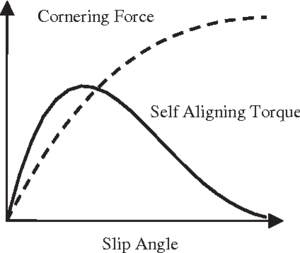
This is where it should be noted that this torque is also non linear, relative to slip angle and to cornering force! What the driver would feel is increasing steering force, then gradually decreasing, while the car is still increasing in cornering force. This is due to the slippage of the contact patch changing location.
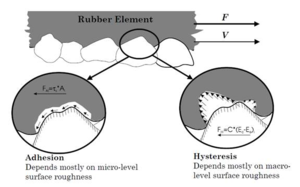
Another factor is the tire’s relationship to vertical load - i.e, why heavier cars dont corner as well as lighter cars. Tires operate with both “adhesion” and “Hysteresis” that can also be called as “mechanical interlocking” on a macro scale with the asphalt. A sidenote - The adhesion is vastly reduced in the rain, but the Hysteresis is not affected.
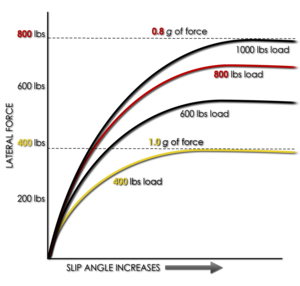
Now, the coefficient of friction of the tire is unitless, and it is the single most important measure of tire performance - or at least, the easiest one to see at a glance. We were taught in highschool physics that this friction coefficient is constant, and independent of surface area. That is not true! On some materials it may stay very near constant. But on a rubber tire, the coefficient is actually negatively correlated to vertical load - load goes up, coefficient goes down. This is substantial enough to be the single biggest justification for making a race-car lighter.
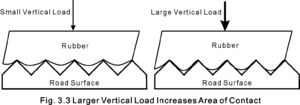
Below, a primary reason for this behavior is seen. This is the macro level “interlocking” of the rubber with the asphalt, a very conventional friction model. As the vertical (i.e normal) load increases, the rubber expands to fill the road ridges, but it begins to saturate (i.e it cannot go any further into the asphalt).
Consequentially, the coefficient = Fcornering/Fnormal decreases, as 1 unit of Fnormal increase results in a <1 unit of Fcornering increase - contributing to the value (being a ratio) to reduce.
Analysis
Tire Testing Consortium (TTC)
Formula SAE tire testing data is available for a one time purchase of $500 from the TTC. http://www.millikenresearch.com/fsaettc.html
Curve Fitting
The Bill Cobb Approach
Bill Cobb has two excellent threads on how to get started fitting. Note: TTC members only
Non-Dimensional Tire Modeling
Based on the Patton 2013 Paper. [1]
- Code is available here: https://www.mathworks.com/matlabcentral/fileexchange/67987-analyzing-tire-test-data
Suggested Reading
- Pacejka, Hans. Tyre and Vehicle Dynamics.
- Clark, Samuel K. (Editor), Mechanics of Pneumatic Tires, 2nd Ed. U.S. Dept. of Transportation, National Highway Traffic Safety Administration, 1981. U.S. Govt. Reference #: 050-003-00377-8.
- Hays, D.F. & Browne, A.L., The Physics of Tire Traction. Plenum, 1973. ISBN 0-306-30806-1.
- Kummer, H.W. & Mayer, W.E., Unified Theory of Rubber and Tire Friction. University Park, PA.: Pennsylvania State University, 1966
- Moore, D.F., The Friction of Pneumatic Tyres. Elsevier, 1975. ISBN 0-444-41323-5.
List of Tires
Formula SAE Tire Test Consortium
Dry
| Make | Model | Size | Weight | Comments | TTC |
| Continental | |||||
| Goodyear | D2704 |
20.0 x 7.0-13 |
8.9LBS | ||
Hoosier [2] |
16.0 x 6.0-10 |
~3.2kg |
|||
| 16.0 x 7.5-10 | ~3.6kg | ||||
| 6.0/18.0-10 | ~3.6kg | ||||
| 18.0 x 6.0-10 | ~4kg | ||||
| 18.0 x 7.5-10 | ~4.5kg | ||||
| 19.5 x 6.5-10 | ~4.5kg | ||||
| 19.5 x 7.5-10 | ~5kg | ||||
| 20.5 x 7.0-13 | ~5kg | ||||
| 20.0 x 7.5-13 |
~5.4kg | ||||
| Pirelli |
Wet
| Make | Model | Size | Weight | Comments | TTC |
| Hoosier | |||||
| Goodyear | D2703 | 20.0x7.0-13 | 8.8LBS |
References
- ↑ Patton, Chris. Development of Vehicle Dynamics Tools for Motorsports. Oregon State University. 2013.
- ↑ https://www.hoosiertire.com/images/content/files/FormulaSAE19(1).pdf


